
shell
ผู้เยี่ยมชม
benducket3211@gmail.com
Can Understanding Tack Welding Pros and Cons Help You Achieve Better Welding Results? (37 อ่าน)
25 ก.ค. 2569 21:08
Understanding tack welding pros and cons is essential for anyone involved in welding, metal fabrication, automotive repair, construction, or industrial manufacturing. Tack welding is the process of creating small temporary welds that hold metal parts together before the final weld is completed. While these welds may appear simple, they play a critical role in maintaining alignment, reducing movement, and ensuring a strong finished joint.
Professional welders recognize that tack welding can significantly improve project accuracy when performed correctly. However, like every welding technique, it also has certain limitations if proper procedures are not followed. Learning the tack welding pros and cons allows welders to choose the best approach for different materials, joint designs, and fabrication projects.
Whether using MIG welding, TIG welding, or stick welding, tack welding serves as the foundation for successful fabrication. From structural steel and pipelines to sheet metal and custom fabrication, understanding both the advantages and disadvantages helps improve weld quality, reduce production errors, and increase overall efficiency.
Tack Welding Pros and Cons for Better Weld Quality
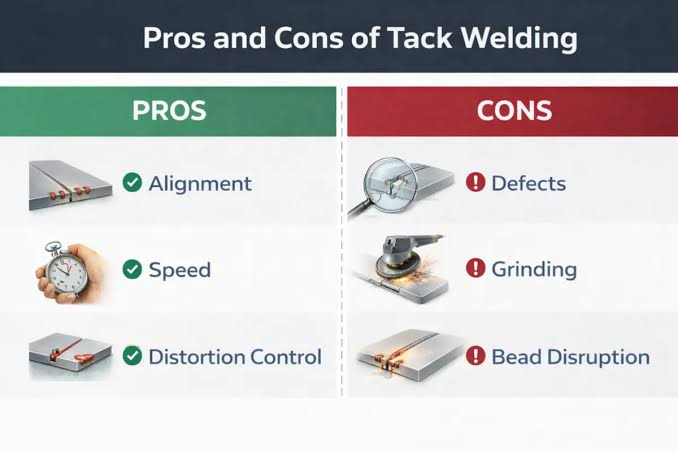
One of the biggest advantages discussed when evaluating tack welding pros and cons is improved alignment. Tack welds temporarily secure metal components in their correct position before permanent welding begins. This prevents parts from shifting due to handling or heat expansion and helps maintain accurate dimensions throughout the fabrication process.
Another significant benefit is distortion control. During welding, metal expands and contracts because of intense heat. Properly placed tack welds help distribute stress more evenly across the joint, reducing the chances of warping or twisting. This is especially important when working with stainless steel, aluminum, or thin sheet metal that is more sensitive to heat.
Tack welding also improves productivity. Fabricators can assemble large structures more efficiently because temporary welds keep components stable while measurements and adjustments are verified. This reduces the likelihood of expensive corrections after final welding is complete. Industries such as automotive manufacturing, structural steel fabrication, heavy equipment production, and pipeline construction rely on tack welding to improve workflow and maintain consistent quality.
Despite these advantages, there are also important drawbacks to consider. Weak or poorly executed tack welds may crack or break during the final welding process, causing alignment issues and additional repairs. Excessively large tack welds may also require extra grinding before permanent welding, increasing labor time and reducing productivity.
Improper heat settings represent another challenge. Too much heat can distort thin materials, while insufficient heat may produce tack welds with poor penetration. Understanding the balance between heat input, welding speed, and material thickness is essential for achieving reliable results.
Tack Welding Pros and Cons Across Industrial Applications
The practical value of understanding tack welding pros and cons becomes even clearer when examining industrial applications. Structural steel fabrication depends heavily on tack welding to hold beams, columns, and support members in precise alignment before final welding. Proper tack weld placement allows engineers and fabricators to verify measurements before creating permanent joints.
Automotive manufacturing also benefits greatly from tack welding. Vehicle frames, body panels, suspension components, and exhaust systems must remain perfectly positioned throughout assembly. Tack welding improves production accuracy while minimizing dimensional errors that could affect safety and performance.
Pipe welding is another industry where tack welding offers major advantages. Proper tack welds maintain consistent root gaps and pipe alignment, helping produce leak-free welds that meet industry standards. However, poor tack weld quality can interfere with root penetration and reduce the strength of completed pipe joints, making careful inspection essential.
Sheet metal fabrication demonstrates both the strengths and weaknesses of tack welding. Small, evenly spaced tack welds effectively control heat distortion and preserve the shape of thin materials. On the other hand, excessive tack weld size or incorrect spacing may introduce unnecessary stress that affects the finished appearance of the product.
Heavy machinery manufacturing, marine engineering, aerospace fabrication, agricultural equipment production, and custom metalworking all depend on tack welding for efficient assembly. Modern inverter welding machines provide stable arc performance and precise heat control, helping welders maximize the advantages while minimizing the disadvantages associated with different fabrication projects.
Tack Welding Pros and Cons for Long-Term Performance
Successfully managing tack welding pros and cons requires attention to preparation, technique, and inspection. Clean metal surfaces are essential for producing strong tack welds. Rust, paint, grease, oil, and moisture should always be removed before welding because contaminants reduce weld quality and increase the likelihood of defects.
Joint fit-up also plays a major role in tack welding success. Properly aligned materials allow tack welds to perform their intended function without excessive stress. Welding clamps, fixtures, and magnetic holders help maintain accurate positioning while temporary welds are applied.
Material thickness influences tack weld size and spacing. Thin sheet metal requires smaller tack welds to minimize heat distortion, while thicker structural steel often needs larger tack welds to prevent movement during fabrication. Selecting compatible filler metals further improves weld integrity and ensures a smooth transition between tack welds and final welds.
Inspection remains one of the most valuable practices in professional welding. Every tack weld should be checked before final welding begins. Cracked, porous, or poorly fused tack welds should be removed and replaced immediately to avoid structural weaknesses later in the project. Experienced welders also alternate tack weld locations across opposite sides of the joint to balance heat distribution and reduce internal stress.
Continuous training and practical experience allow welders to better understand the tack welding pros and cons in real-world situations. Improved control over arc length, travel speed, electrode angle, and heat input leads to stronger temporary welds and higher-quality finished products. As welding skills develop, operators become more efficient while reducing defects and unnecessary rework.
Conclusion
Understanding tack welding pros and cons is essential for achieving accurate, durable, and professional-quality welds. Tack welding provides important advantages, including improved alignment, reduced distortion, increased productivity, and stronger final weld preparation. At the same time, improper tack weld size, poor heat control, inadequate penetration, and insufficient inspection can negatively affect the quality of the finished joint.
By applying proper preparation techniques, maintaining accurate fit-up, controlling heat input, and carefully inspecting every tack weld, fabricators can maximize the benefits while minimizing the limitations of this essential welding process. Whether working in structural steel fabrication, automotive manufacturing, pipeline construction, sheet metal production, or custom metalworking, understanding tack welding pros and cons helps create stronger welds, improve efficiency, and deliver reliable results that meet professional industry standards.
43.242.176.123
shell
ผู้เยี่ยมชม
benducket3211@gmail.com